


AI in Healthcare: A Strategic Application Sector for ANITI
The use of Artificial Intelligence (AI) techniques in the healthcare sector is a rapidly expanding research area. It is a priority topic within the national AI strategy and is featured in several national and international research programs and calls for projects.
Hybrid AI to Support Healthcare Professionals
Based on the hybrid and multidisciplinary approaches central to ANITI, which combine machine learning techniques with logical, biological, or physical models, advancements in various fields of AI are at the heart of future medicine. Applied across numerous healthcare sectors, these advancements notably enable the improvement of care quality, better patient management, and the design of new treatments tailored to each individual.
Leveraging heterogeneous, multidimensional, and complex data, AI assists healthcare professionals in several ways: making earlier and more reliable diagnoses, identifying relevant biomarkers to better understand the evolution of certain pathologies, proposing personalized treatments and care pathways, and facilitating operations assisted by advanced robotics, imaging, or digital twins, among other applications.
The application of AI in healthcare is vast and has potential for further expansion. Crucially, this also raises significant questions concerning the social acceptability of these approaches, the respect for data confidentiality and privacy, and ethical considerations—all topics strongly represented in ANITI’s research themes.
The “AI for Health” Program: One Ambition, Multiple Themes
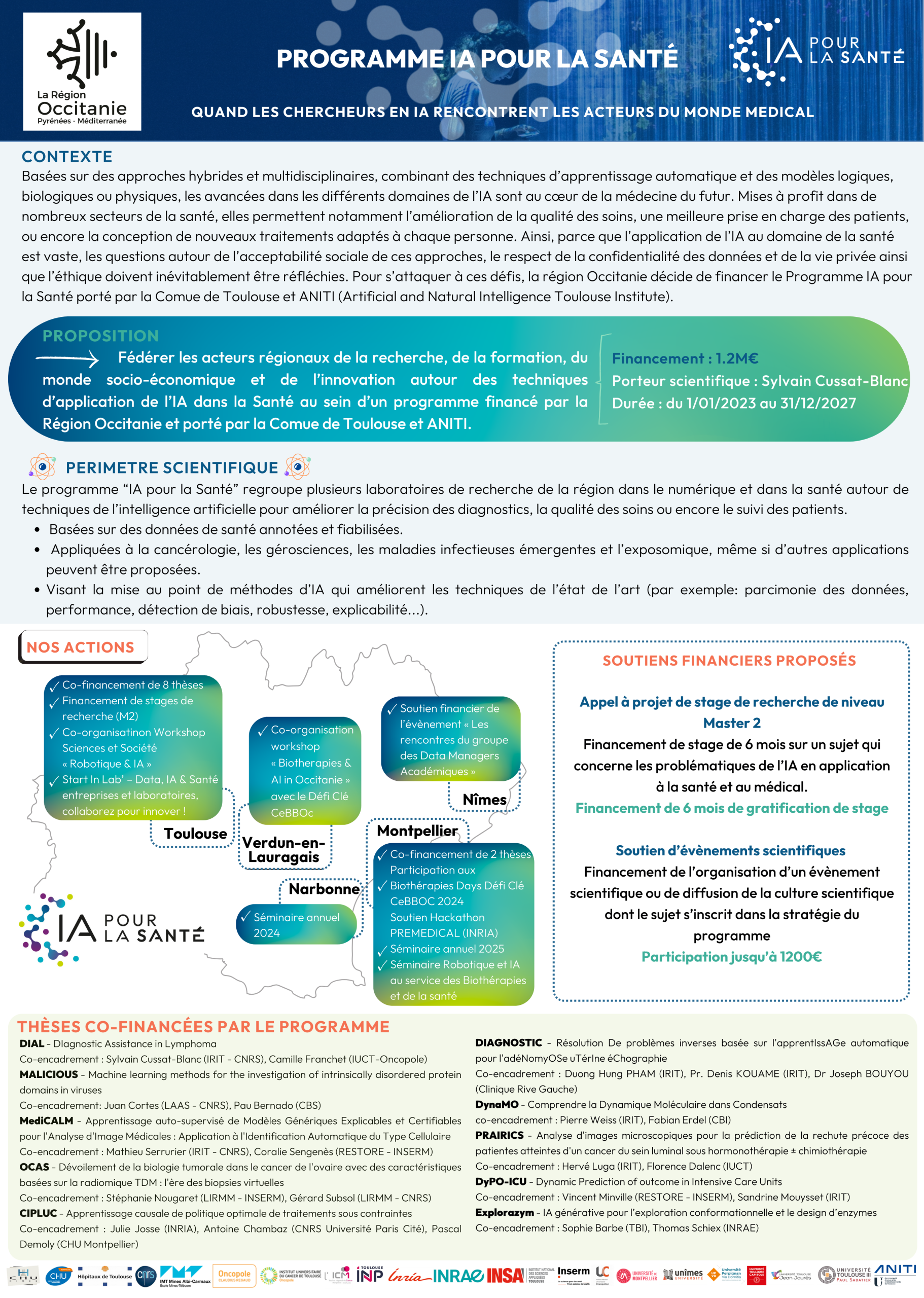
In early 2023, the “AI for Health” program, supported by the Occitanie Region and led by ANITI, was launched.
The region represents an ideal area to tackle these challenges. It benefits from high-level university potential and an innovation ecosystem in the fields of health, biology, biotechnologies, and digital technology, particularly in the cities of Toulouse, Montpellier, and Nîmes.
Mission
This program aims to bring together regional stakeholders in research, training, the socio-economic world, and innovation around AI application techniques in health. It strengthens the links and synergies between AI researchers and medical professionals in the Occitanie Region, notably represented within its governing bodies.
Themes:
Certain strong themes represent differentiating points for Occitanie. Thus, at national and international levels of biomedical research, opportunities and needs for the development of AI research are well identified:
- Oncology (Cancer Research)
- Geroscience (Healthy Aging)
- Exposomique
These themes, among others, will naturally be at the core of the initial work carried out under this program.
Call for projects
As part of its two 2025 and 2026 seed funding calls, the AI for Health program is providing a total of €139,780 in funding for seed projects led by research teams and clinical and industrial partners from the Occitanie region and beyond. These projects explore innovative applications of artificial intelligence in diagnosis, patient care, and the development of new therapies.
The 2025 winning projects
PRONAIA – Artificial Intelligence-Enhanced Predictive Models for Oncology
We aim to develop a virtual model, or “digital twin,” that can predict how the leukemic cells and their surrounding environment changes during chemotherapy. This model will help scientists and doctors understand why some treatments stop working and why relapses occur. It will also assist in identifying biological markers that can guide better treatment decisions. To make the model as accurate as possible, we will use advanced computer simulations and biological data from cutting-edge biological techniques. The model will learn and improve using AI-driven methods. Ultimately, this technology could lead to a powerful new tool for predicting treatment outcomes, improving personalized medicine, and supporting drug development. We plan to patent and bring it to market for real-world medical applications.
MiCARE – Precision Control of Microbial Cell Therapies Through AI-Driven Receptor Engineering
The development of innovative bacterial therapies capable of detecting pathological biomarkers and producing therapeutics in situ is an emerging field of research. This project focuses on engineering synthetic receptors to program the detection capabilities of therapeutic bacteria. In particular, we focus on a key region of the receptor known as the “juxtamembrane (JM) linker,” which plays a crucial role in signal transmission. Our goal is to develop advanced artificial intelligence techniques to understand and control the functional properties of this linker and to design more precise and effective bacterial therapies. This work paves the way for smarter, more targeted medical treatments.
NANODIAG – AI-based multistate design of cysteine-less Nanobody® scaffolds for clinical diagnostics.
Antibodies are major tools for detecting pathogens or disease marker in clinical diagnosis. Common diagnostic assays rely on antibodies derived from immunized animals, which are huge proteins, difficult and expensive to produce but then easy to label with chemicals that give a signal in diagnosis. A Novel format of mini-antibodies, called nanobodies, has emerged as an interesting alternative, as they can be produced at low cost and in high amount without animal experimentation. However, chemical labeling of nanobodies often leads to impaired binding to the target. Therefore, we aim to use AI-based design methods to generate new mutated nanobody formats that will fulfill the requirements for easy labeling while preserving their small size and stability and thus develop next generation diagnosis assays.
ReMedIA: Interactive recommendation system for action plans regarding the collaborative, cross-departmental management of medication errors.
Medication errors (MEs) pose a significant risk to patient safety. Helping healthcare professionals analyze these serious adverse events associated with care in order to prevent their occurrence is a key challenge. Currently, adverse event review meetings are handled in isolation, without leveraging past experiences or sharing knowledge. This project proposes a recommendation tool powered by artificial intelligence to assist healthcare professionals in analyzing and preventing MEs. Through a collaborative approach, hospital departments will be able to pool their experiences and enrich a dynamic knowledge base that serves as a decision-support resource. Incorporating user feedback will allow for the continuous refinement of recommendations, thereby reducing the risk of error recurrence.
The 2026 winning projects
GENEPI – Generation, decoding, and semantic analysis of the latent space of an autoencoder applied to iEEG time series
Epilepsy affects approximately 1% of the population, and nearly a third of patients do not respond to standard treatments. To better assist them, doctors analyze brain signals recorded directly from the brain (iEEG), looking for specific oscillations known as “Fast Ripples.” These signals are difficult to detect because they are intermingled with various other types of brain activity or background noise. This project employs artificial intelligence capable of learning to represent these signals in a simplified form known as “latent space.” This representation enables the automatic identification of different signal types, including those that are not yet well classified. The AI will also be able to learn to generate realistic brain signals to help clean and enrich the existing database. Ultimately, this approach could significantly improve the diagnosis of patients suffering from treatment-resistant epilepsy.
SYNGP – Generation of explainable synthetic health data using a GAN with a Cartesian Genetic Programming-based generator.
Synthetic data make it possible to replicate the behavior of real-world health data while preserving patient privacy. They offer a way to accelerate the research and development of AI solutions without handling sensitive information. However, current methods rely on powerful yet hard-to-interpret models, which hinders their adoption in the healthcare sector. This project explores a new approach that combines a generative model with a method capable of revealing the rules the model learns. The goal is not only to produce realistic artificial data but also to understand how that data is generated. With the support of the Intensive Care Unit at the Toulouse-Rangueil University Hospital, the study will evaluate the clinical quality of the generated data and verify that the model’s learning mechanisms remain consistent with medical reality.
BIOGEN-PET – BIOdistribution-guided GENeration for PET/CT
This project aims to accelerate the development of AI tools for PET/CT oncology imaging in a rapidly expanding theranostic landscape. It addresses two major bottlenecks: the reliance of deep networks on large annotated cohorts and the difficulty of keeping pace with the fast emergence of new radiotracers. We propose a PET/CT synthetic image generation framework guided by biodistribution priors to produce physiologically consistent and configurable data. In parallel, we will develop a
data-efficient learning scheme to improve multi-protocol robustness and cross-tracer transferability. The proposed components will be evaluated on public datasets and Pixilib private data. The industrial objective is to build a platform that anticipates the clinical availability of new radiotracers, with a clear TRL upscaling pathway and a reusable foundation for future calls, including longer-term prospects toward digital twins.
HGRL-DIR – Human-Guided Reinforcement Learning for Deformable Image Registration improved (MRI/4D-C)
This project aims to improve the temporal alignment of medical images, particularly for monitoring cancer patients. Currently, such alignments rely primarily on deep learning methods that do not always reflect medical reality. We propose an innovative approach that directly incorporates input from medical experts while ensuring the continuous improvement of the algorithms. By leveraging this human feedback, our method consistently yields images that are better aligned and anatomically more realistic, as well as organ contours that are consistent across images and tailored to the specific user.
Ultimately, these improvements enhance the reliability of images used for treatment planning by reducing errors caused by patient movement and increasing clinician confidence in digital tools.